
SaaS Product Strategy, MVP Engineering & Launch · Software solution
Build the smallest SaaS product that can test the right product bet
Turn a specific customer problem into a focused, testable subscription software product.
We define, design, and engineer SaaS MVPs around a priority user workflow, with accounts, roles, onboarding, billing readiness, administration, analytics, release controls, and product learning planned as one system.
Product discovery and MVP decisions Accounts, roles, and core workflow Launch learning and product ownership
Last reviewed:

SaaS MVP development
SaaS MVP development for focused, multi-user subscription products
We help founders and product teams turn a specific customer problem into a focused SaaS MVP. Product discovery, the priority user workflow, accounts and permissions, billing readiness, administration, analytics, launch controls, and learning measures are planned as one product rather than an expanding list of features.
What makes a SaaS MVP ready for a controlled launch?
- Define the target user, product hypothesis, priority journey, release boundary, risks, and evidence the MVP must produce
- Engineer accounts, organizations or workspaces, roles, permissions, core records, onboarding, administration, integrations, and billing readiness
- Launch with tested product journeys, defined analytics and feedback paths, documented ownership, known limits, and an evidence-led next-release plan
Validate a product bet
Product decisions, multi-user architecture, and launch learning in one MVP
A SaaS MVP is not a compressed backlog of every future feature. We identify a valuable user and problem, define one complete workflow, model the account and permission structure, decide what billing and administration need now, and build enough measurement and operational control to learn from a real release.
Product discovery and MVP strategy
Convert the product idea into a bounded release with a clear audience, problem, value proposition, risks, and learning goals.
- Target user, problem, and product hypothesis
- Existing evidence, assumptions, and competitor context
- Priority journey and MVP boundary
- Release criteria, product measures, and decision backlog
Multi-user SaaS foundation
Design the product model behind the interface so users, organizations, permissions, and data ownership behave consistently.
- Account, organization, or workspace model
- Authentication, invitations, roles, and permissions
- Core records, states, and data relationships
- Onboarding, administration, support, and recovery paths
Core workflow, billing, and integrations
Engineer the complete workflow customers are expected to use, with the services and commercial controls required by the approved release.
- Responsive product interface and core workflow
- Backend logic, APIs, and approved integrations
- Subscription, entitlement, or billing readiness
- Validation, errors, notifications, and operational exceptions
Launch readiness, analytics, and product handover
Prepare the product for real users, support, observation, and an informed next release rather than treating deployment as the finish line.
- Functional, permission, device, and integration QA
- Product events, analytics, and feedback capture
- Deployment, environment, and launch checklist
- Documentation, ownership, known limits, and next-release priorities
Designed forTeams with a specific product problem and a user workflow worth testing - not an unbounded request to build an entire future platform
- Founders validating a focused subscription product
- SMEs productizing a proven internal workflow
- Teams replacing an over-scoped or fragile first version
- Organizations preparing a multi-user product for controlled launch
A learning-led MVP process
From product hypothesis to a usable, measurable release
We keep product, experience, engineering, commercial readiness, and launch operations connected. Every release slice should complete a meaningful user outcome and answer a product or technical question; the roadmap changes only through visible decisions, not quiet scope accumulation.
01
SaaS workflowDefine, model, build, test, learn
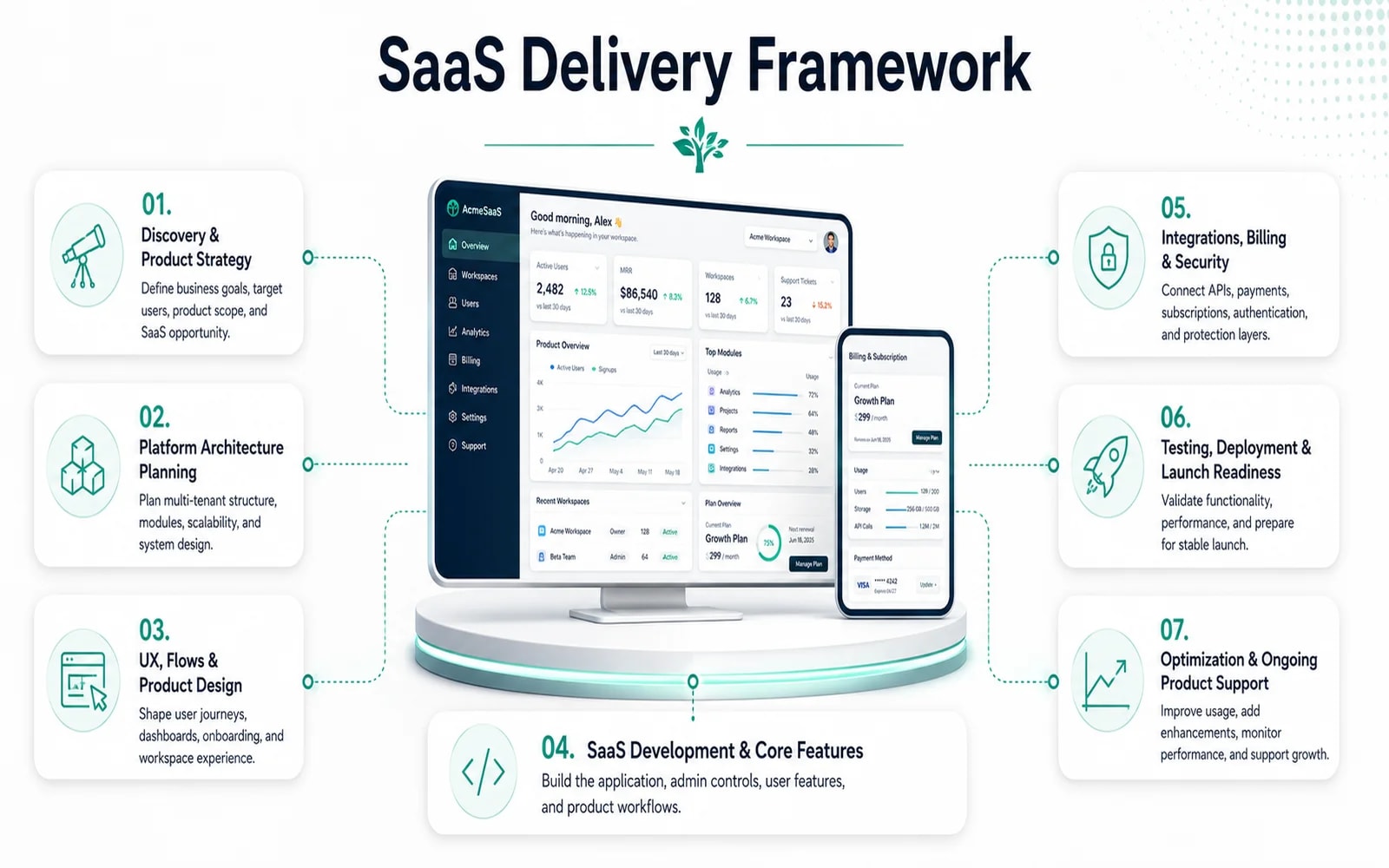
Define the user, problem, and product bet
Clarify the target user, painful problem, current alternatives, evidence, commercial model, constraints, success measures, and the most important assumptions the first release must test.
Model accounts, roles, and the core workflow
Define the account and role model, core records, workflow states, onboarding, administration, billing boundary, integrations, edge cases, and a prioritized acceptance-ready release scope.
Build and review complete release slices
Design and engineer complete product slices, demonstrate them against user outcomes, test permissions and exceptions, and keep new requests visible in the decision backlog.
Test, launch, measure, and plan the next release
Validate critical journeys, data and account behavior, analytics events, environments, support paths, and launch controls; release to the agreed audience and use evidence to plan what comes next.
Product thinking with engineering depth
The customer problem, product model, and operating reality stay connected
A technically working application can still be a weak MVP if it tests no clear assumption, leaves account behavior ambiguous, or cannot be supported after launch. We make the product choices, system boundaries, commercial dependencies, evidence, and ownership visible throughout delivery.
SaaS product capabilities
Next.jsNode.jsSQL databasesAuthenticationRole-based accessSubscription and billing integrationsProduct analyticsCloud deployment
02
Working principlesLearn before you expand
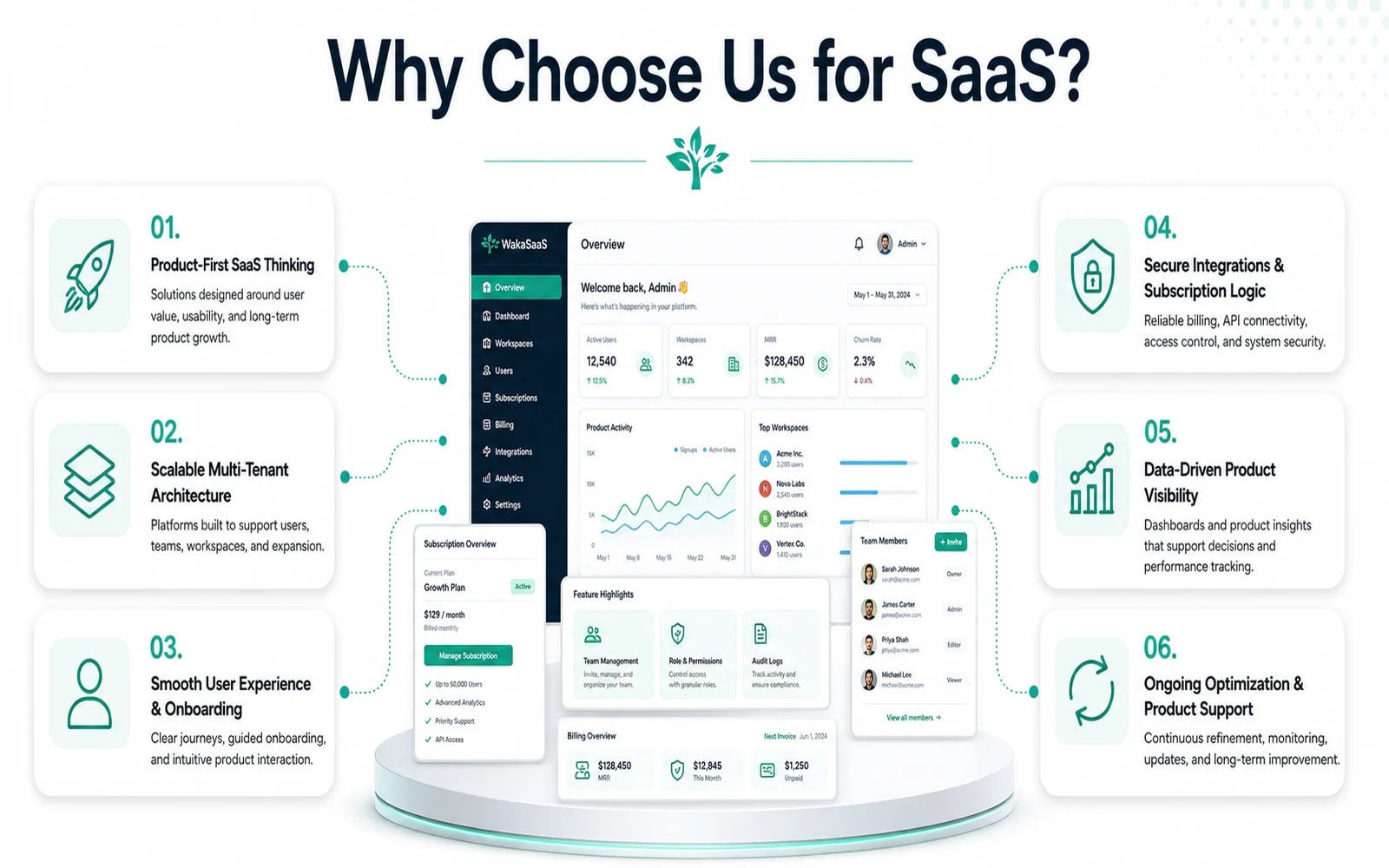
One complete outcome first
The MVP centers on the smallest coherent journey that delivers user value. Secondary roles, reports, settings, and integrations earn their place by supporting that outcome or making the release operable.
Multi-user behavior is designed
Accounts, organizations, invitations, roles, entitlements, ownership, isolation, administration, and recovery are product requirements - not generic infrastructure details to add later.
Launch is an experiment with owners
We define what will be observed, how feedback reaches the team, who handles support and incidents, and which evidence will justify keeping, changing, or stopping the next feature investment.
Questions, answered
SaaS FAQ
Direct answers about SaaS MVP scope, multi-user architecture, billing, integrations, product-market fit, launch, and ownership.
Ask about your projectWhat can a SaaS MVP engagement include?
The scope can include product discovery, assumption and evidence review, MVP prioritization, journeys and interface design, account and organization models, authentication, roles and permissions, the core workflow, backend and data engineering, approved integrations, billing or entitlement readiness, onboarding, administration, analytics events, QA, cloud deployment, launch planning, documentation, and product handover. The exact release is defined around one customer problem and measurable learning goal.
How is a SaaS MVP different from Custom Software Development?
A SaaS MVP is a repeatable product intended for multiple customers or organizations, usually with onboarding, accounts, permissions, commercial access, support, and product learning. Custom Software Development is shaped around a specific organization's roles, records, business rules, and operations. Some systems can evolve from one category to the other, but the account model, roadmap, and commercial assumptions need to be explicit.
How do you decide what belongs in the MVP?
We start with the target user, problem, desired outcome, current alternative, available evidence, main risk, and the decision the release should enable. Features are included when they complete the priority journey, make the product safe and operable, or produce essential learning. Useful ideas that do not meet those tests are recorded for later rather than quietly added to the first release.
Can the product support organizations, teams, and different permission levels?
Yes, when those behaviors are part of the approved product model. We define whether data belongs to a person, workspace, organization, or another boundary; how users join; what each role can view or change; how administrators support accounts; and how isolation and permissions are tested. We do not assume one generic multi-tenant pattern fits every product.
Do you implement subscriptions and billing?
We can design billing readiness and integrate an approved billing provider when it belongs in scope. That may include products or plans, trials, entitlements, checkout, subscription states, webhooks, failed-payment behavior, invoices, account changes, and administrative visibility. Tax, accounting, legal terms, and commercial policy remain client and specialist responsibilities unless separately agreed.
Can you connect the MVP to existing systems or third-party services?
Yes, where suitable APIs, webhooks, identity methods, or provider workflows exist. We document the data exchanged, authentication, failure and retry behavior, limits, privacy considerations, environments, test cases, monitoring, and ownership so the integration is not treated as an invisible dependency.
Will an MVP guarantee product-market fit, funding, users, or revenue?
No. Software delivery cannot guarantee market demand, adoption, funding, or commercial results. We can help make the product hypothesis explicit, remove avoidable delivery ambiguity, create a usable release, and implement practical measurement and feedback paths. The market evidence still has to come from real users and business execution.
What do we receive at launch and handover?
Typical outputs include the working product, source and deployment guidance, account and permission model, data and integration notes, analytics-event plan, environment and launch checklist, known limitations, support and incident ownership, administrative guidance, and a prioritized backlog informed by what the first release is meant to learn.
Featured Insights
Stories of Digital Transformation Across Services and Industries
From Idea to Impact




Start with the product bet
Turn your SaaS idea into a focused MVP decision and release plan.
Tell us who the product is for, which problem it should solve, what evidence you already have, and what the first release must teach you. We will help define the smallest credible scope and the technical foundation it needs.