
Mobile Product Strategy, UX & Engineering · Professional service
Build a mobile product that works beyond the happy path
Mobile products designed around real journeys, device conditions, and operational needs.
We plan, design, engineer, and prepare mobile apps for customer self-service, staff workflows, connected services, and focused product launches across iOS and Android.
Mobile product strategy Cross-platform engineering Device QA and release readiness
Last reviewed:

Mobile product strategy, UX, and engineering
Mobile app development for complete iOS and Android product journeys
Waka Consulting plans, designs, engineers, and prepares mobile apps for customer self-service, staff workflows, connected services, and focused product launches. Engagements can cover product discovery, mobile UX, cross-platform development, backend and device integrations, offline behavior, device QA, analytics, store preparation, and operational handover.
What makes a mobile app ready for real users?
- Mobile product strategy and UX with user-context research, journey mapping, feature prioritization, prototypes, states, interruptions, and success measures
- Cross-platform app engineering with responsive components, application state, backend APIs, authentication, notifications, device services, and offline-ready workflows
- Device QA and release readiness with representative device checks, network and failure-state testing, analytics, diagnostics, store preparation, and owner handover
From product decision to release readiness
Mobile delivery across product, experience, engineering, and operations
A mobile app is more than a smaller website. We shape the user journeys, device behavior, backend dependencies, permissions, interrupted states, release requirements, and support ownership that determine whether the product works in everyday conditions.
Mobile product strategy and UX
Clarify the product problem, target users, device context, and smallest complete mobile journey before development begins.
- Product discovery and feature prioritization
- Customer, staff, or field-user journey mapping
- Mobile information architecture and interaction direction
- Prototype scope, assumptions, and success measures
Cross-platform app engineering
Turn the approved experience into a maintainable application for the agreed iOS and Android device range.
- Responsive mobile screens and reusable components
- Navigation, state, forms, and error handling
- Accessibility and platform-behavior review
- Reviewable builds and product demonstrations
Backend and device integrations
Connect the app to the services and device capabilities required for a complete user workflow.
- Backend APIs, authentication, and account flows
- Push notifications, file or media handling, and deep links
- Payments, maps, or third-party services when required
- Offline, retry, sync, and permission behavior where relevant
Device QA and release readiness
Verify critical journeys on representative devices and prepare the product, team, and release materials for handover.
- Device, operating-system, and orientation checks
- Network interruption and failure-state testing
- Analytics, diagnostics, and release configuration
- Store-submission preparation and operational runbook
Designed forTeams with a defined user problem that genuinely benefits from device access
- Founders validating a mobile product
- Service businesses adding customer self-service
- Teams replacing fragmented field workflows
- Organizations extending an existing platform to mobile users
Mobile product delivery
From user context to tested app release
We agree the target users, platforms, critical journeys, integrations, device constraints, release responsibilities, and learning goals before committing to a full feature set. Each stage produces something the product and operational owners can review.
01
Product workflowDiscover, prototype, build, test, release
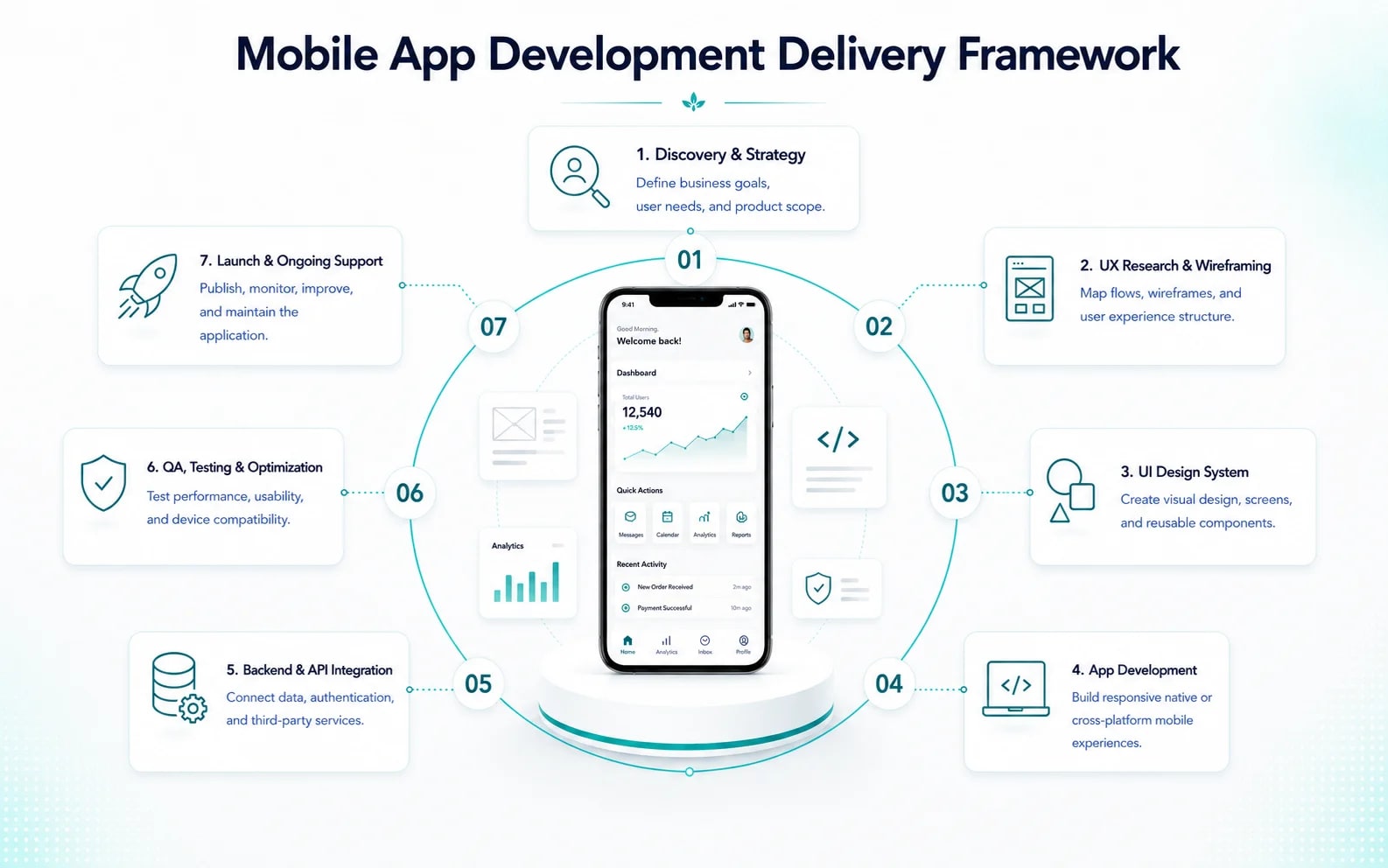
Define users and mobile context
Define the users, mobile context, business workflow, target platforms, backend dependencies, constraints, and evidence needed to prioritize the first release.
Prototype and validate core journeys
Map priority journeys, design key states and interruptions, test a prototype, and agree which assumptions must be resolved before implementation expands.
Build the app and integrations
Build the interface and application logic in reviewable releases, connect approved APIs and device services, and demonstrate complete journeys rather than isolated screens.
Test devices and prepare release
Test critical paths on representative devices and network conditions, address release issues, prepare store materials, and hand over support and measurement guidance.
Product thinking meets mobile engineering
One team across journeys, integrations, devices, and release
Mobile products fail at the seams between interface decisions, backend behavior, permissions, network conditions, and operational ownership. We keep those responsibilities visible throughout delivery so the app is judged as a complete service, not a collection of screens.
Mobile delivery capabilities
React NativeiOS and AndroidAPIsAuthenticationPush notificationsOffline-ready workflowsProduct analyticsRelease workflows
02
Working principlesComplete journeys over feature volume
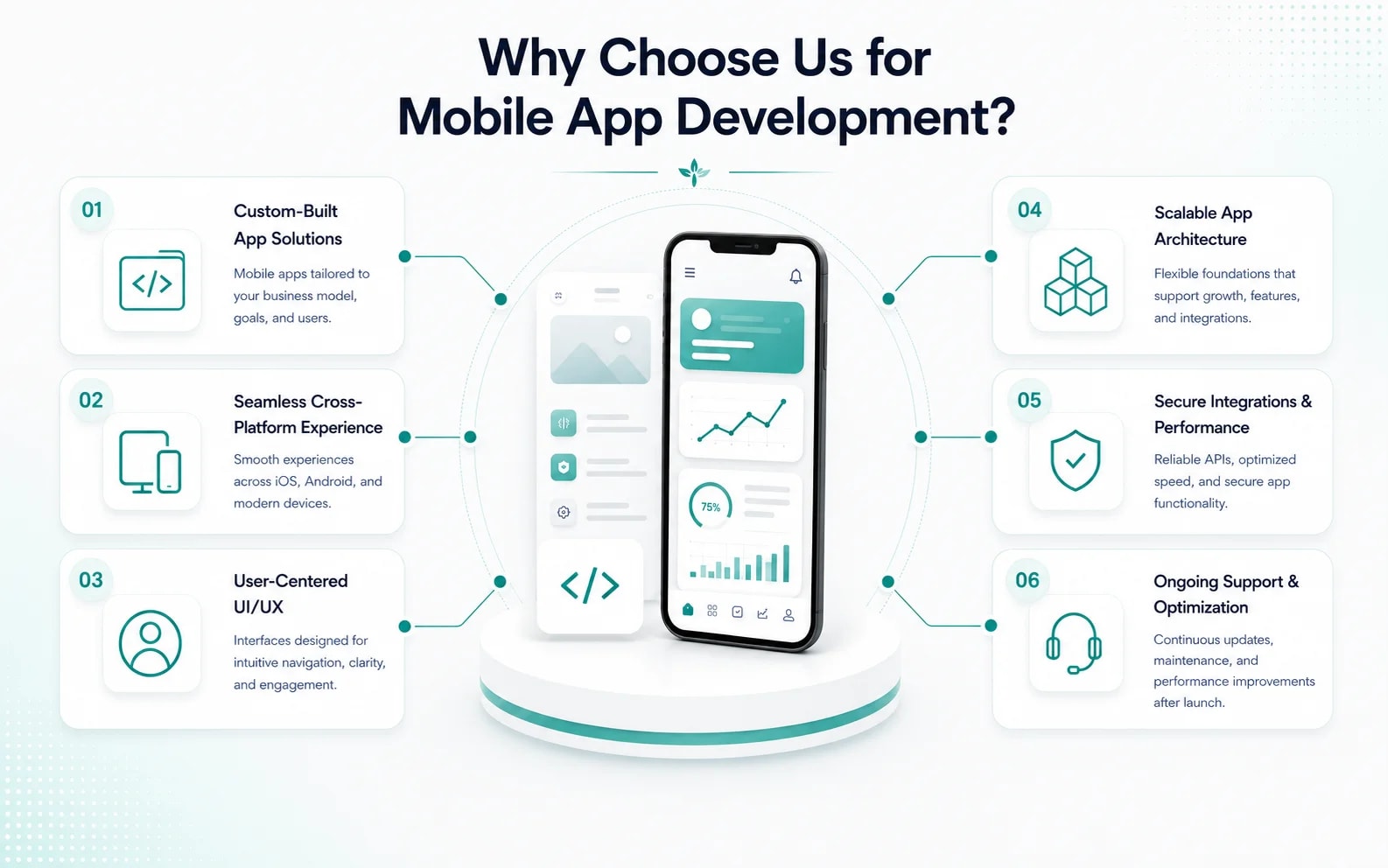
Mobile context comes first
Journeys account for smaller screens, touch input, interruptions, permissions, variable connectivity, and the situations in which users actually reach for the app.
Backend behavior stays visible
Authentication, loading, sync, retries, empty states, errors, notifications, and third-party dependencies are designed and tested as part of the experience.
Release is a shared responsibility
The handover covers device QA, analytics, diagnostics, store preparation, ownership, and the next learning cycle—not only a source-code delivery.
Questions, answered
Mobile App Development FAQ
Direct answers about app strategy, iOS and Android delivery, integrations, offline behavior, testing, store preparation, and handover.
Ask about your projectWhat can a mobile app engagement include?
The scope can include product discovery, user journeys, feature prioritization, mobile UX and prototyping, cross-platform engineering, backend APIs, authentication, notifications, payments or other integrations, offline and sync behavior, analytics, device QA, store-submission preparation, documentation, and post-release improvement. We confirm the platforms, device range, integrations, and release responsibilities before work begins.
Should we build a mobile app or a responsive website?
A responsive website is often the better first choice when users mainly discover information, submit simple forms, or arrive through search and campaigns. A mobile app becomes more appropriate when the service needs repeat use, device capabilities, notifications, offline behavior, stored sessions, or a focused staff or customer workflow. Discovery should test that decision before committing to app development.
Do you build separate native iOS and Android apps?
The recommended approach depends on the required device capabilities, performance, platform-specific behavior, budget, timeline, and internal maintenance needs. Cross-platform delivery can reduce duplicated work for many products, while some requirements justify native platform work. We document the tradeoff rather than assuming one approach fits every app.
Can the app connect to our existing backend or business systems?
Yes, when suitable APIs, permissions, and data rules are available. We assess the existing services, identify missing endpoints or workflow gaps, define error and synchronization behavior, and separate mobile-interface work from any backend remediation or new API development required.
Can the app work with weak or unavailable connectivity?
Offline and interrupted-network behavior can be designed when the workflow requires it. The scope must define what data can be stored locally, which actions can be queued, how conflicts are resolved, what the user sees during failure, and which operations must remain online for security or consistency reasons.
Do you guarantee approval by the Apple App Store or Google Play?
No provider can guarantee platform approval. We can prepare builds and submission materials, review common policy and technical requirements, and respond to review feedback within the agreed scope. Final approval remains with the platform and can be affected by the app, content, accounts, payments, privacy disclosures, and changing store requirements.
How do you test a mobile app before release?
Testing can cover priority journeys, supported devices and operating-system versions, screen sizes, permissions, authentication, integrations, loading and failure states, network interruption, notifications, accessibility, analytics, and release configuration. The final matrix is based on the product risk and agreed device support.
What do we receive at handover?
Typical outputs include the agreed product scope, flows and interface designs, application source, integration documentation, test and release notes, environment and account guidance, analytics or diagnostics configuration, known limitations, operational ownership, and a prioritized post-release backlog.
Featured Insights
Stories of Digital Transformation Across Services and Industries
From Idea to Impact





Start with the mobile decision
Turn your app idea into a focused, testable product plan.
Tell us who will use the app, what they need to complete, which systems it must connect to, and why a mobile product is the right channel. We will help define the first complete journey and the safest next step.