
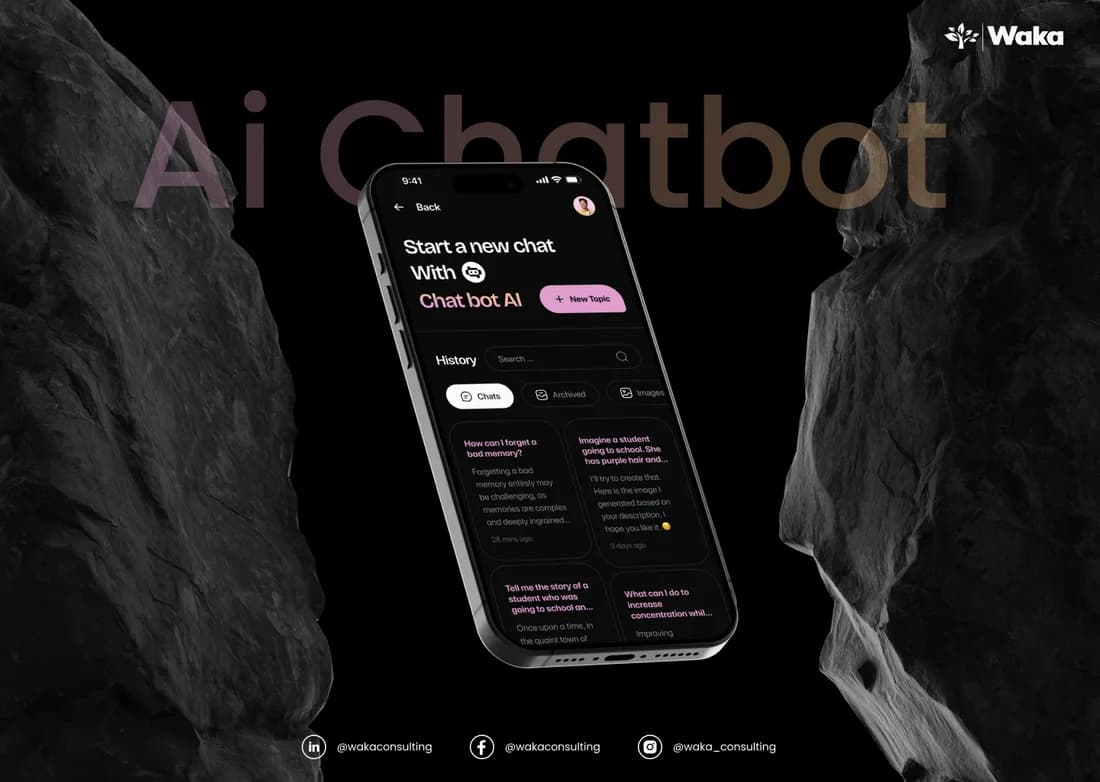
Designing an AI Chatbot That Reduces the Blank-Canvas Problem
This AI chatbot concept explores a common product challenge: helping users move from an open text box to a useful task while keeping conversation history understandable and reusable.
What is the recommended approach?
The interface supports the work before, during, and after a generated response.
What product problem does AI Chatbot address?
The product needs to reduce uncertainty for new users while preserving open-ended interaction for experienced users. It must also communicate model limits, privacy expectations, and the difference between generated output and verified information.
An open prompt field looks simple, but it transfers the entire burden of understanding the product to the user. People must know what the assistant can do, how to ask, and how to recover useful work later.
How should the experience be structured?
The interface supports the work before, during, and after a generated response.
The concept adds lightweight orientation around the conversation: topic creation, visible examples, searchable history, and organization patterns. The aim is to help users begin and return without turning the interface into a complicated command center.
Which product design decisions matter most?
Prioritise decisions that make the main journey understandable, trustworthy, and usable before expanding the feature set.
- Give topic creation a clear entry point: Guide the first useful action
- Make history meaningful: Past work should be reusable
- Use examples as orientation: Examples teach product scope
- Reserve space for trust information: Trust is a product feature
What should the product direction achieve?
The direction expands the AI experience beyond an empty prompt by connecting orientation, conversation, review, and reusable history.
- A clearer entry point for starting purposeful work
- Searchable and recognizable conversation history
- A product structure that can accommodate trust and limitation guidance
Questions teams ask before they begin
Is this the NeuroPulse project?
The local artwork shows an AI chatbot, while older site copy used the name NeuroPulse for a decision-intelligence dashboard. This page follows the visible evidence and does not claim they are the same product.
Does the concept include a production AI model?
No production model, accuracy result, or live deployment is claimed.
What would production require?
A production build would require model selection, safety evaluation, data controls, retention rules, prompt and response logging policy, abuse prevention, accessibility, monitoring, and clear user guidance.
What supports this guide
This page documents the AI chatbot shown in Waka's portfolio artwork. It does not use the historical 'NeuroPulse' decision-intelligence label because that description conflicts with the visible asset. No model accuracy, productivity, adoption, or production metrics are claimed.
- AI Risk Management FrameworkUS National Institute of Standards and Technology
Turn the guide into a practical project plan
Waka can help clarify the workflow, define the right first release, and create a delivery plan around your users, risks, and business goals.