
Application Maintenance, Incident Support & Small Improvements · Professional service
Give your live product a controlled path from issue to tested maintenance release
Keep live websites and applications understandable, supportable, and safe to change after launch.
We take ownership of a controlled post-launch backlog covering diagnosis, defects, dependency and security updates, small integrations and improvements, maintenance releases, monitoring follow-up, incident learning, documentation, and recurring risk review.
Takeover, diagnosis, and backlog control Tested fixes, updates, and integrations Incident learning, reporting, and ownership
Last reviewed:

Website and application maintenance
Maintenance and support for controlled post-launch changes, incidents, and risks
Waka Consulting helps teams take responsible ownership of existing websites and applications after launch. We establish the product and access baseline, triage and diagnose issues, maintain dependencies and approved integrations, deliver bounded fixes and small improvements, test maintenance releases, follow up incidents, update documentation, and keep risks and next actions visible.
What makes application maintenance dependable?
- Take over source, hosting, accounts, domains, data, dependencies, integrations, monitoring, backups, release paths, support history, documentation, and known risks
- Triage and diagnose incidents and defects, deliver approved fixes, dependency and security updates, integration maintenance, and small improvements with proportionate regression checks
- Release and validate changes through an agreed path, document incidents and decisions, report recurring faults and open risk, and maintain a prioritized support backlog with clear owners
Controlled care for live software
A known baseline, prioritized backlog, tested change, and accountable follow-up
Maintenance is not an unlimited promise to fix anything immediately. We establish the product, access, dependency, integration, monitoring, and support baseline; agree how issues are reported and prioritized; diagnose before changing code; test releases in proportion to risk; and keep incidents, limitations, decisions, and next actions visible.
Product takeover and maintenance baseline
Build enough understanding of the live product to make responsible changes and expose missing access, documentation, ownership, or recovery assumptions.
- Repository, hosting, domain, data, account, and access inventory
- Application, dependency, integration, monitoring, and support-history review
- Build, test, release, rollback, backup, and recovery baseline
- Known issues, risks, constraints, owners, and takeover priorities
Incident diagnosis, bug fixes, and corrective work
Create a repeatable path for reporting, reproducing, diagnosing, prioritizing, correcting, and learning from production issues.
- Issue intake, severity, impact, evidence, and reproduction guidance
- Logs, diagnostics, data, integration, and recent-change review
- Corrective fix, workaround, or escalation recommendation
- Incident timeline, affected scope, validation, and follow-up actions
Dependency, security-update, and integration maintenance
Maintain the application and its approved connections through bounded changes with dependencies, failure paths, and ownership understood.
- Dependency, runtime, CMS, plugin, or framework updates
- Security-update triage and application within agreed responsibility
- API, webhook, email, payment, analytics, or service maintenance
- Small approved improvements, compatibility checks, and technical-debt items
Planned releases, reporting, and ownership handover
Release maintenance work with visible checks and provide a recurring view of completed work, open risk, incidents, and decisions needed next.
- Change review, representative regression checks, and release notes
- Deployment, post-release validation, monitoring, and rollback readiness
- Work completed, incidents, recurring faults, risks, and blocked items
- Documentation updates, owner decisions, and next-cycle backlog
Designed forTeams responsible for an existing live product - new product builds and major platform changes require a separate development or DevOps scope
- Teams without consistent post-launch engineering capacity
- Businesses inheriting an undocumented website or application
- Live products with recurring defects, dependency risk, or integration failures
- Organizations needing a controlled maintenance backlog and release rhythm
A visible maintenance cycle
From product takeover and issue evidence to tested change and recurring review
We agree the supported systems, environments, channels, priorities, response expectations, maintenance capacity, release authority, and exclusions before urgent work sets the rules by accident. Each change moves through diagnosis, approval, testing, release, validation, and documentation appropriate to its risk.
01
Support workflowBaseline, triage, diagnose, change, verify, review
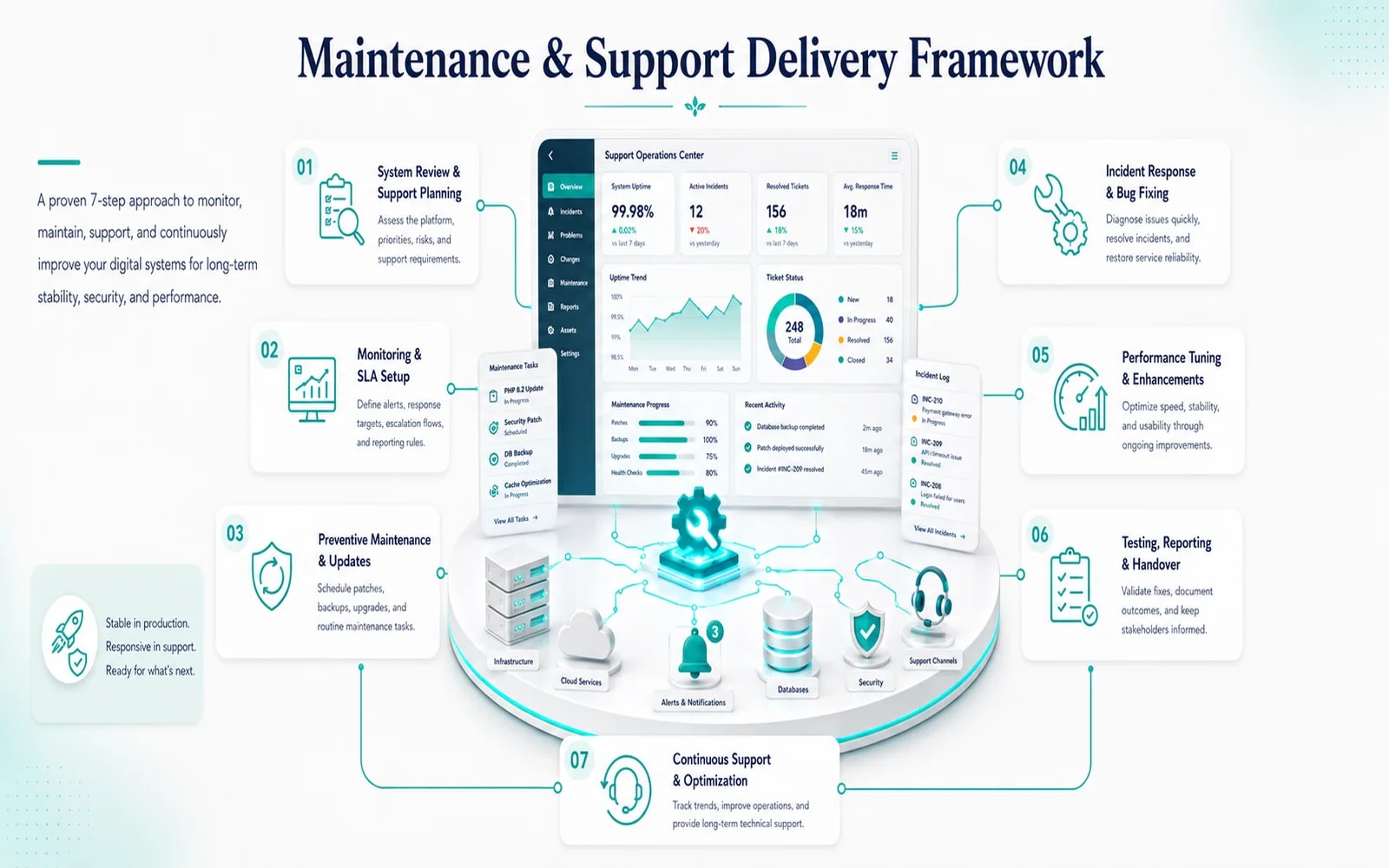
Audit the product, access, dependencies, and support history
Inventory the live product, source, hosting, domains, data, environments, accounts, dependencies, integrations, monitoring, backups, release method, support history, current risks, and the access needed to investigate safely.
Triage incidents, risks, and the maintenance backlog
Establish issue intake and evidence requirements, classify impact and urgency, reproduce where possible, identify workarounds or containment, prioritize the backlog, and flag work that belongs in another service scope.
Implement, test, and release approved changes
Diagnose root or contributing causes, implement approved fixes, updates, integrations, or small improvements, review dependencies and regressions, and prepare a release with rollback and validation steps appropriate to the change.
Review health, incidents, risks, and the next maintenance cycle
Deploy through the agreed path, verify the affected journey and operational signals, document the change and any incident learning, review recurring faults and open risks, and agree the next maintenance priorities.
Support built on context
Diagnosis, change control, and product ownership stay connected
Live-product support becomes fragile when fixes are rushed without reproduction evidence, access depends on one person, integrations have no owner, or recurring incidents never change the backlog. We preserve context across issues and releases so each intervention improves both the product and the team's ability to operate it.
Maintenance and support capabilities
Issue trackingVersion controlDependency reviewRelease QAMonitoring and diagnosticsAPIs and webhooksSupport runbooksMaintenance reporting
02
Working principlesDiagnose before changing production
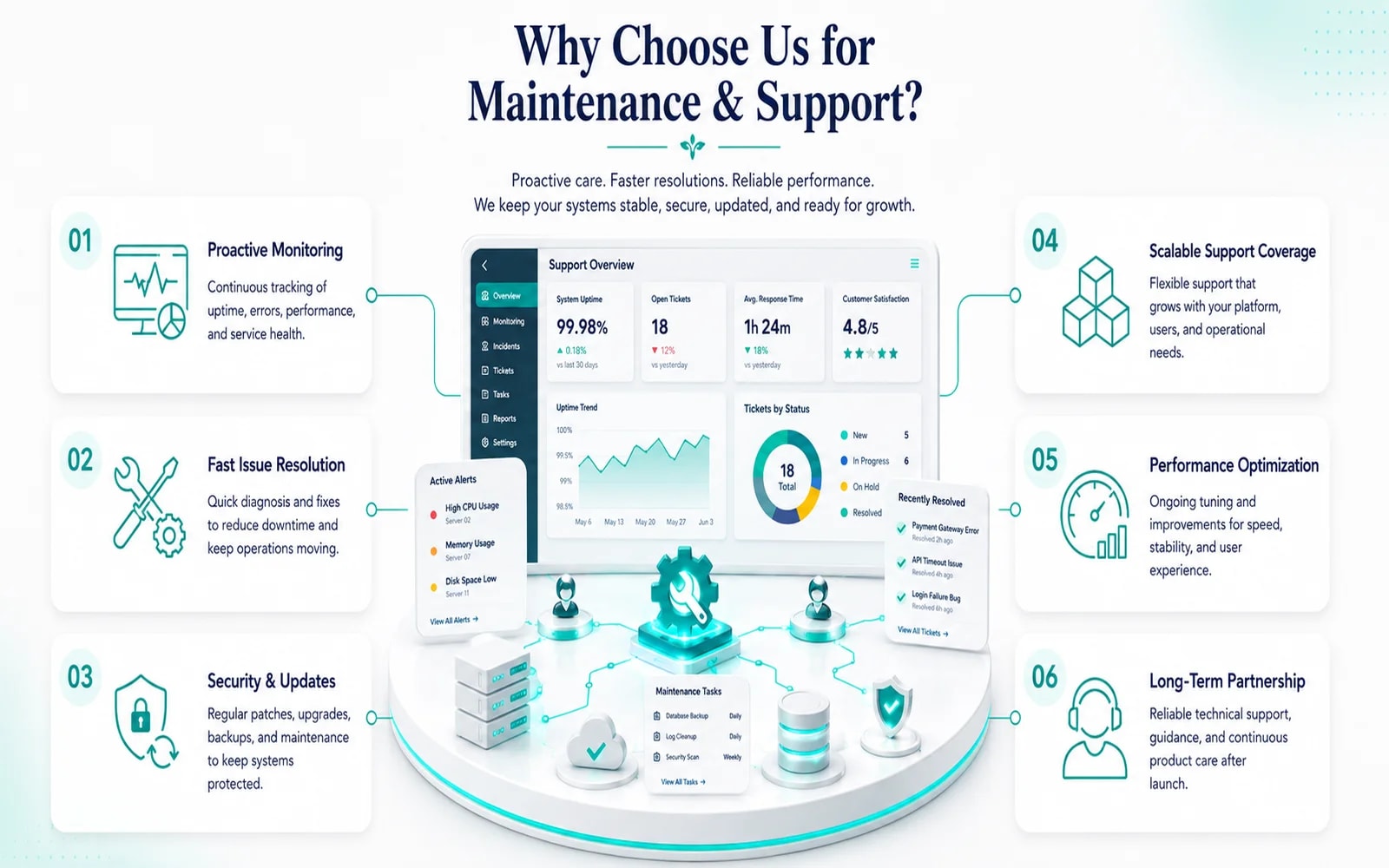
Priority follows impact and evidence
Urgency is evaluated against affected users and workflows, business impact, security or data risk, reproducibility, available workaround, and dependency on other providers - not only the order requests arrive.
Small changes still need release discipline
Bug fixes, dependency updates, content-system changes, and integration adjustments can create regressions. Review, testing, release notes, post-release validation, and rollback readiness are scaled to the risk rather than skipped.
Support boundaries are explicit
Supported systems, channels, hours or response targets, capacity, release authority, exclusions, third-party responsibilities, emergency handling, and escalation paths are agreed in the engagement; they are not implied by the word support.
Questions, answered
Maintenance & Support FAQ
Direct answers about product takeover, bug fixes, incidents, support availability, dependencies, security updates, integrations, releases, reporting, and the DevOps boundary.
Ask about your projectWhat can a Maintenance & Support engagement include?
The scope can include product and access takeover, issue intake and triage, diagnosis, bug fixes, dependency and runtime updates, security-update handling, CMS or plugin maintenance, API and webhook repairs, small approved integrations or improvements, regression checks, maintenance releases, post-release validation, monitoring follow-up, incident review, documentation, risk reporting, and backlog planning. Supported systems, capacity, channels, response expectations, and exclusions are agreed explicitly.
Can you take over a product built by another team?
Often, yes. We first assess whether the repository, hosting, accounts, domains, data, build process, environments, dependencies, integrations, monitoring, backups, documentation, and access are sufficient for responsible support. Missing access, unsupported technology, licensing issues, severe defects, or an unsafe release path may require a paid takeover or stabilization phase before routine maintenance begins.
Do you provide emergency or 24/7 support?
Not by default. Support channels, coverage periods, response targets, severity definitions, capacity, contacts, and escalation arrangements must be written into the engagement. If continuous or out-of-hours incident coverage is required, it needs a specifically designed operating model; the general service page does not promise instant response or resolution.
How is Maintenance & Support different from DevOps?
Maintenance & Support owns the ongoing application backlog: diagnosis, defects, dependency updates, small approved integrations and improvements, maintenance releases, incident follow-up, and recurring reporting. DevOps owns the delivery and operating platform: environments, CI/CD, containers, hosting, migration, observability, backup, rollback, and recovery controls. We can coordinate both when an application issue exposes an infrastructure or release-platform problem.
How do you prioritize maintenance requests?
We consider affected users and workflows, business impact, security or data risk, severity, reproducibility, workaround availability, regression risk, effort, deadlines, and dependency on client or third-party action. The agreed capacity and response model determine what can be handled in a cycle; a large new feature or rebuild is estimated separately rather than hidden inside maintenance.
Do dependency or security updates make the product secure or compliant?
No. Timely updates can address known issues in supported components, but application security and compliance also depend on architecture, configuration, access, code, data handling, providers, process, testing, and ongoing ownership. High-risk findings, penetration testing, formal audits, or compliance programs belong in a dedicated cybersecurity scope.
Can you maintain third-party APIs, webhooks, payments, email, or analytics integrations?
Yes, where access is authorized and the providers expose usable interfaces and support. We can diagnose mappings, authentication, webhooks, retries, failures, version changes, limits, and data flow within the agreed systems. Provider outages, discontinued features, account restrictions, fees, or undocumented behavior remain external dependencies and may require vendor or client action.
What reporting and handover do we receive?
Typical outputs include the supported-system and access inventory, prioritized backlog, issue evidence and decisions, work completed, release and validation notes, dependency or integration changes, incidents and recurring themes, open risks and blocked items, updated runbooks or documentation, account and owner actions, and priorities for the next cycle. If support ends, we prepare an orderly handover of the maintained context.
Featured Insights
Stories of Digital Transformation Across Services and Industries
From Idea to Impact




Start with the live product
Turn recurring issues and uncertain ownership into a controlled maintenance plan.
Tell us what is live, who built it, where it runs, what keeps breaking or falling behind, and which access and documentation exist. We will recommend the right takeover, stabilization, or ongoing support scope.