
Release Engineering, Cloud Migration & Reliability · Professional service
Turn fragile deployments into a controlled path from source to recovery
Make environments, deployments, migrations, rollback, and recovery deliberate engineering responsibilities.
We assess and improve how applications move from source to production through controlled environments, CI/CD, containers, cloud migration, access boundaries, observability, backups, rollback, recovery exercises, and documented operational ownership.
Environments and delivery controls Migration, deployment, and rollback Observability, backup, and recovery readiness
Last reviewed:

DevOps and release engineering
DevOps services for controlled environments, releases, migration, and recovery
Waka Consulting improves the operating path from source code to production and recovery. DevOps engagements can cover application and dependency discovery, environment separation, CI/CD, containers, cloud or hosting migration, access and configuration controls, observability, backups, restore checks, rollback, incident runbooks, and accountable operational handover.
What makes a delivery platform safe enough to operate?
- Assess repositories, dependencies, environments, build and release paths, hosting, data, domains, access, incidents, backups, recovery assumptions, and ownership gaps
- Design and implement appropriate build, test, artifact, approval, deployment, configuration, secret, migration, validation, and rollback controls
- Verify releases, observable health signals, alerts, backup restoration, recovery steps, escalation, known limits, runbooks, and accountable operational ownership
Control the path to production
Environments, automation, migration, observability, and recovery connected
DevOps is not a collection of cloud tools. It is the operating design behind how changes are built, checked, promoted, observed, reversed, and recovered. We map the application and its dependencies, make environment and access boundaries explicit, automate appropriate release controls, and verify the runbooks people will depend on when normal delivery fails.
Delivery, environment, and reliability assessment
Establish how the application is built and operated today, where delivery depends on manual knowledge, and which reliability risks deserve priority.
- Application, service, data, domain, and third-party dependency map
- Development, testing, staging, and production environment review
- Current build, release, access, incident, backup, and recovery workflow
- Risk register, constraints, ownership gaps, and prioritized engineering plan
CI/CD, containers, and environment controls
Create repeatable build and release controls with clear promotion, configuration, access, and failure behavior across agreed environments.
- Build, test, artifact, deployment, and approval workflow
- Container and runtime configuration where appropriate
- Environment variables, secrets, permissions, and separation
- Release gates, logs, notifications, rollback triggers, and runbook
Cloud migration, cutover, and rollback planning
Plan and execute cloud or hosting changes as staged operational events with dependencies, data, cutover, validation, and reversal considered together.
- Current and target architecture with dependency inventory
- Migration stages, rehearsals, data movement, and compatibility checks
- DNS, certificates, traffic cutover, validation, and communication plan
- Rollback criteria, restore points, maintenance window, and decision owners
Observability, backup, recovery, and operations handover
Give operators enough signal and tested recovery guidance to detect meaningful failures, respond, restore service, and improve the system afterward.
- Application and infrastructure health signals
- Actionable alert routes, thresholds, context, and owners
- Backup coverage, retention assumptions, and restore verification
- Incident, rollback, recovery, escalation, and handover documentation
Designed forTeams improving how software is hosted and released - ongoing application bugs and small product changes belong in Maintenance & Support
- Teams relying on manual or fragile deployments
- Businesses moving a live application or leaving unsuitable hosting
- Products with inconsistent development, staging, and production environments
- Organizations formalizing backup, recovery, and release ownership
A risk-led DevOps process
From undocumented release paths to exercised operational controls
We begin with dependencies and failure consequences, then design the smallest useful set of environments, automation, gates, signals, rollback, and recovery controls. Changes are introduced in reviewable stages and judged through release and recovery scenarios rather than tool installation alone.
01
Delivery workflowDiscover, design, automate, migrate, verify, hand over
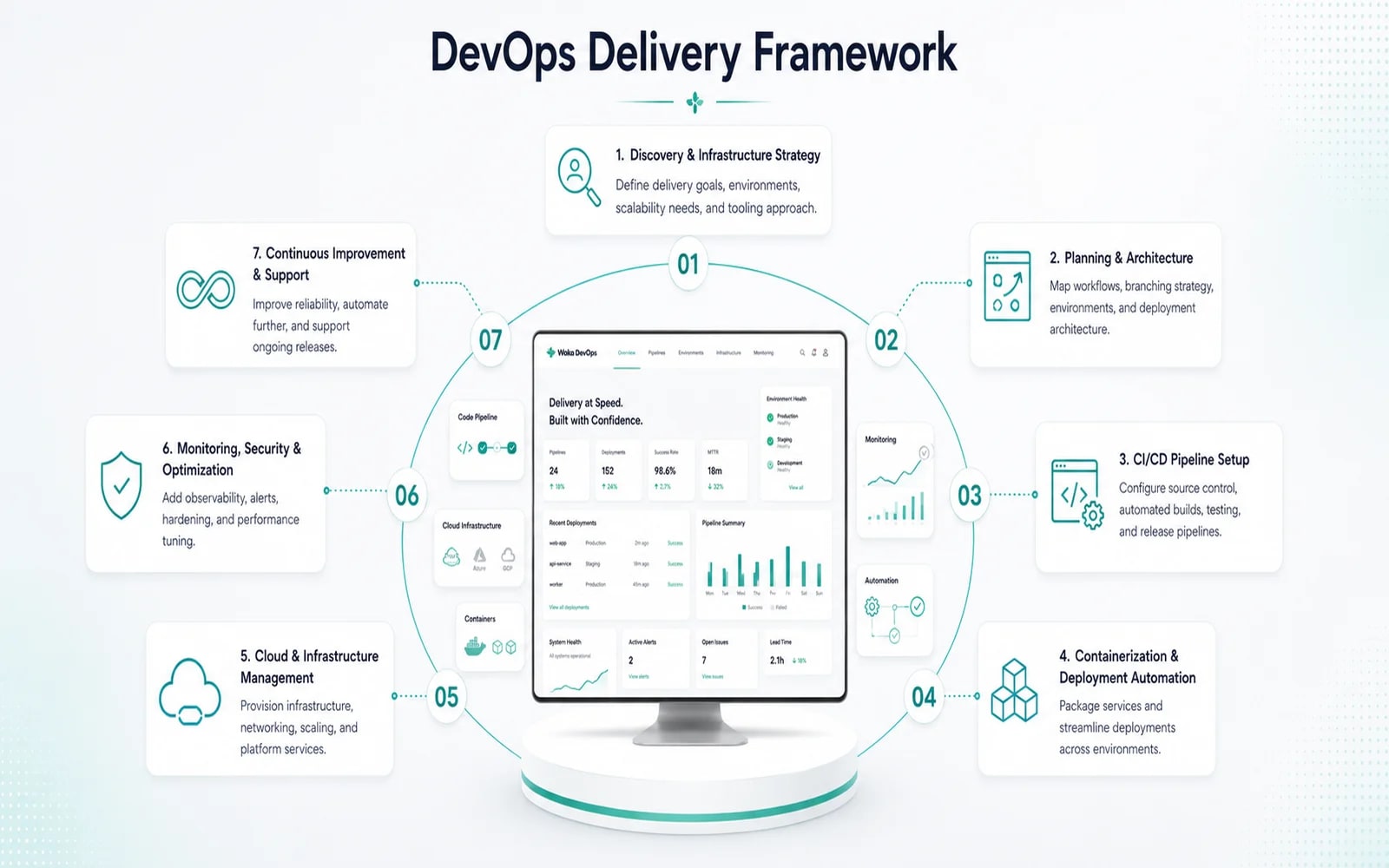
Map dependencies, environments, and the current release path
Map source repositories, build steps, artifacts, environments, hosting, data stores, domains, integrations, access, current releases, incidents, backups, constraints, owners, and the business impact of likely failures.
Design delivery controls, migration stages, and rollback
Define target environment boundaries, configuration and secret handling, build and promotion stages, tests and approvals, migration waves, cutover gates, observable signals, rollback criteria, and accountable decisions.
Implement and exercise pipelines, environments, and operational controls
Implement the approved pipeline, container or runtime configuration, environments, access controls, monitoring, alerts, backups, and migration steps; exercise changes in lower-risk stages before production cutover.
Verify releases, recovery, observability, and owner handover
Verify representative releases, failed deployments, rollback, health signals, alerts, backups, restoration, incident escalation, and ownership; document known limits and the operational improvement backlog.
Delivery and recovery designed together
A release is not reliable until failure has an observable, owned response
Automation alone can make unsafe changes happen faster. We connect pipelines to environment separation, access, migration controls, meaningful signals, rollback decisions, backup restoration, and runbooks so the team understands both the normal path and what happens when it breaks.
DevOps engineering capabilities
DockerCI/CD workflowsCloud hostingEnvironment configurationAccess and secret managementMonitoring and alertingBackups and restore checksRelease runbooks
02
Working principlesMake change reversible and failure visible
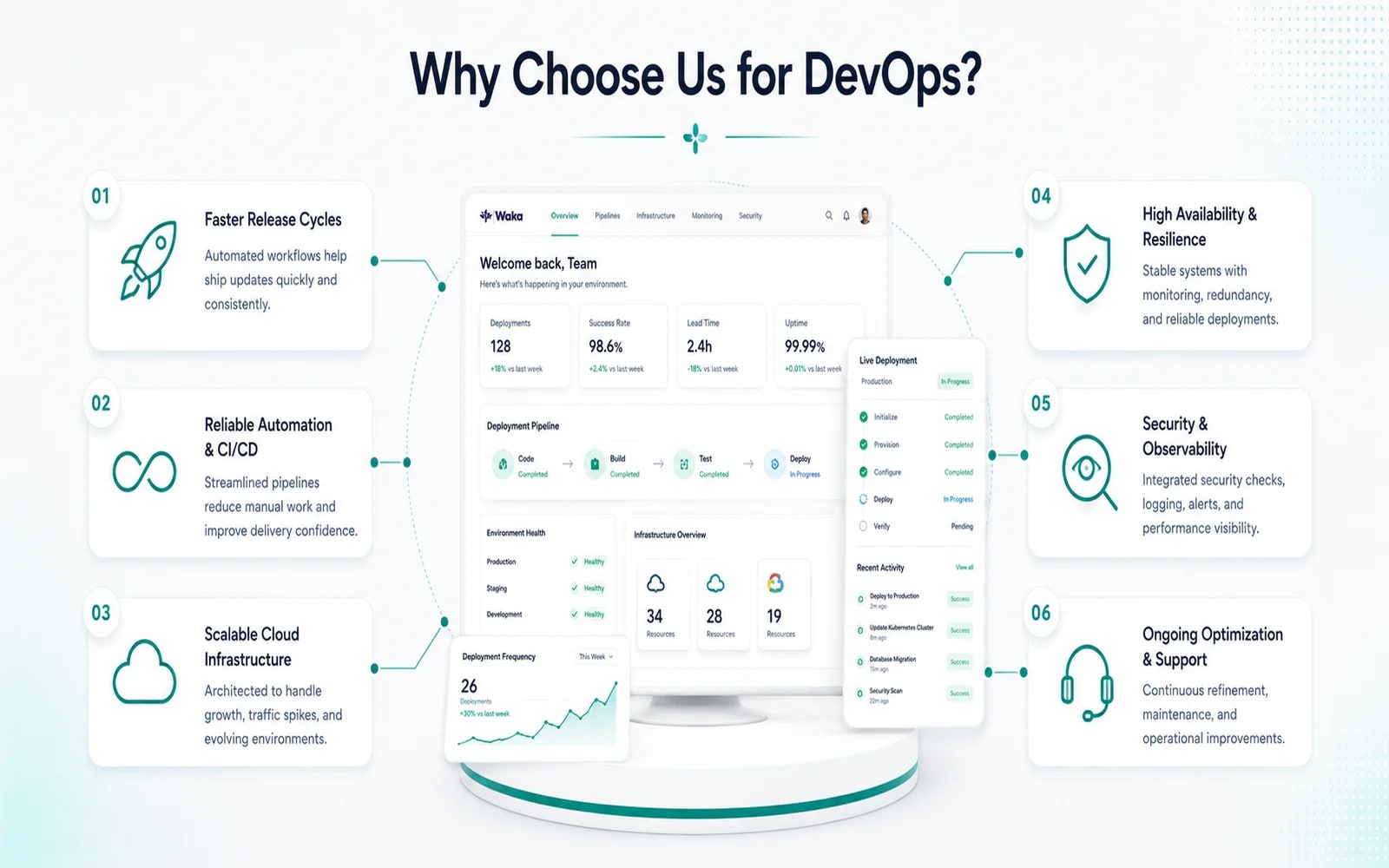
Automate an understood release
The current path, required checks, approvals, artifacts, configuration, and owners are clarified before automation. A pipeline should encode an agreed operating model rather than hide an undocumented one.
Migration has decision gates
Dependencies, data, compatibility, rehearsal, cutover, validation, communication, rollback criteria, and decision authority are planned together. No infrastructure change is described as risk-free or guaranteed zero-downtime.
Recovery must be exercised
A backup file or rollback button is not proof of recovery. We define what must be restored, acceptable assumptions, access, order of operations, validation, owners, and practical checks within the agreed scope.
Questions, answered
DevOps FAQ
Direct answers about environments, CI/CD, containers, cloud migration, downtime, monitoring, backups, recovery, access, and the Maintenance & Support boundary.
Ask about your projectWhat can a DevOps engagement include?
The scope can include application and dependency discovery, environment review, build and release mapping, CI/CD design and implementation, container or runtime configuration, cloud or hosting architecture, access and secret handling, migration planning and execution, DNS and certificate cutover, monitoring and alerting, backups, restore checks, rollback, incident and recovery runbooks, documentation, and operational handover. The exact controls follow the application risk and systems already in place.
How is DevOps different from Maintenance & Support?
DevOps owns the delivery and operating platform: environments, pipelines, artifacts, deployments, hosting, migrations, observability, backup, rollback, and recovery controls. Maintenance & Support owns the ongoing application backlog after launch: diagnosis, bug fixes, dependency updates, small approved integrations or improvements, maintenance releases, incident follow-up, and reporting. A support issue can reveal a DevOps need, but the two scopes should remain visible.
Can you migrate our live application or database?
Yes, when discovery confirms the access, compatibility, capacity, timing, and operational conditions required. We inventory dependencies, design migration stages, determine data movement and synchronization needs, rehearse where practical, define cutover validation and rollback criteria, and assign decision owners. Unknown dependencies or unsuitable source systems may require remediation before migration.
Do you build CI/CD pipelines for an existing product?
Yes. We review the repository, build and test commands, artifacts, environments, configuration, secrets, approvals, deployment method, hosting target, rollback needs, and team practices before implementing the workflow. The pipeline can automate appropriate checks and promotions, but it cannot compensate for missing tests or unclear release ownership without addressing those gaps.
Can you guarantee zero downtime, perfect uptime, or incident-free releases?
No. Infrastructure and releases depend on application behavior, providers, networks, data changes, third parties, traffic, and human decisions. We can reduce avoidable risk through architecture, rehearsals, staged change, health checks, rollback, backups, recovery planning, monitoring, and clear ownership. Any availability target or maintenance window must be agreed for the actual system.
What monitoring and alerting do you implement?
We select signals that help an owner recognize and diagnose meaningful failure, such as service health, errors, latency, job or integration failure, resource pressure, or backup status where appropriate. Alerts need thresholds, context, routing, escalation, and review; collecting logs and metrics without an accountable response path is not sufficient.
Does having backups mean the application can be recovered?
Not by itself. Recovery depends on what is backed up, frequency, retention, encryption and access, dependencies, compatible infrastructure, restoration order, data consistency, validation, and the people authorized to act. We can document those assumptions and perform proportionate restore or recovery checks within scope; outcomes and limitations are recorded rather than implied.
What do we receive at operational handover?
Typical outputs include the current and target architecture, environment and release model, pipeline and deployment configuration, migration and rollback records, access and secret ownership guidance, monitoring and alert routes, backup and recovery notes, release and incident runbooks, known limitations, account ownership, and a prioritized reliability backlog.
Featured Insights
Stories of Digital Transformation Across Services and Industries
From Idea to Impact




Start with the release path
Turn your deployment or migration risk into a controlled engineering plan.
Tell us how the application is built and released today, which environments and providers are involved, what has failed before, and what must be protected during change. We will recommend the right DevOps assessment and delivery scope.