
Designing a Travel Experience That Moves Across Devices
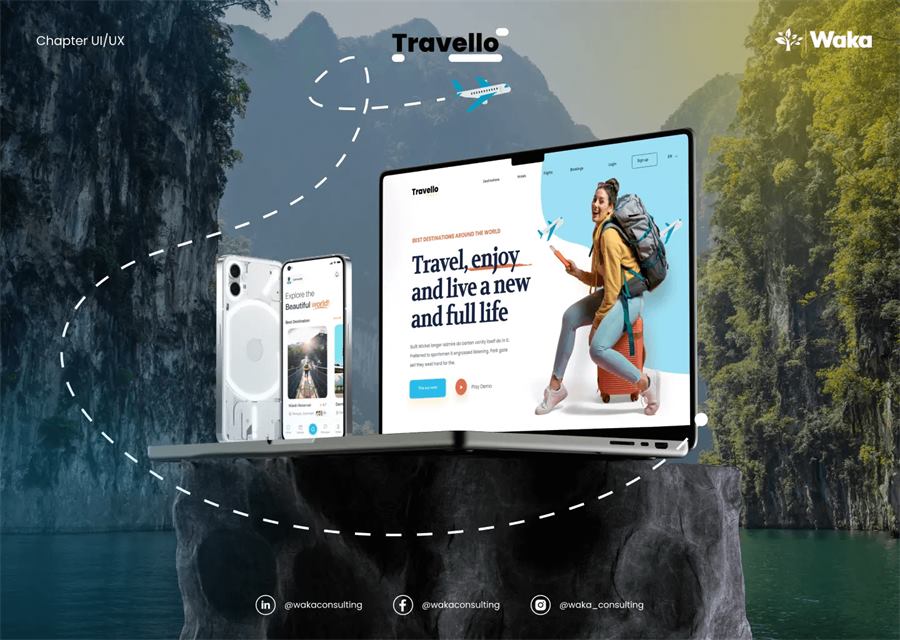
Travello explores a continuous travel journey that begins with inspiration, becomes a practical plan, adapts while the traveler is moving, and remains useful after the trip.
- Project type
- Cross-device concept
- Primary audience
- Independent travelers
- Waka's role
- Product UX and UI
- Outcome
- Travel journey direction
One trip journey across planning and travel moments
Travel planning rarely happens in one session or on one device. People move between inspiration, comparison, saved ideas, practical booking information, and live destination context. Products that treat these as separate experiences create repeated work and lost intent.
Travello connects those moments through a shared trip model. Rich discovery supports inspiration, structured planning turns ideas into decisions, and mobile access keeps the most useful details available while the traveler is moving.
Balancing inspiring content with practical decisions
Travel interfaces need to create desire while still helping people compare, organize, and act. The product also has to present personalization and sustainability information as useful context rather than as noise or unsupported promises.
Preserve saved intent between web and mobile.
Move smoothly from destination inspiration to practical planning.
Surface live trip information without overwhelming the traveler.
Present sustainability context at moments where it can influence a decision.
The choices that shaped the product direction
The concept was developed as a connected system. Each decision supports the same outcome: helping a learner understand what to do without unnecessary explanation.
Design one trip object across devices
Saved places, plans, and useful details belong to the same trip rather than separate desktop and mobile experiences.
Continuity reduces repeated workSeparate inspiration from commitment
Exploration can remain visual and open-ended while planning introduces dates, priorities, and comparison only when the traveler is ready.
Match the decision stageMake live context glanceable
Mobile views prioritize the information a traveler may need immediately instead of shrinking the full planning interface onto a smaller screen.
Design for the momentPlace sustainability inside choices
Carbon or impact information is most useful beside route, transport, or itinerary decisions where alternatives can be understood.
Context makes impact actionableA continuous journey from possibility to experience
The framework gives each product moment a clear role while preserving the same trip context.
Inspire
Explore destinations and save possibilities without premature detail.
Plan
Compare options and turn ideas into an organized trip.
Adapt
Access live context and adjust plans while traveling.
Reflect
Retain useful history, preferences, and future inspiration.
A cross-device direction for the full travel lifecycle
- Travel journey map
- Discovery hierarchy
- Trip-planning model
- Web and mobile direction
- Live-context priorities
- Sustainability information pattern
A connected concept for travel planning and in-trip use
The result demonstrates how web and mobile can support different travel moments without fragmenting the user's saved intent or trip context.
A shared trip model across devices
Clear separation between inspiration and practical planning
Mobile priorities designed around live travel situations
What product teams can reuse from this work
- Cross-device design is about continuity, not identical screens.
- Inspiration and planning require different information densities.
- Mobile travel interfaces should prioritize immediate context.
- Sustainability information is most useful when attached to a real decision.
About the project and its evidence
Is Travello a live booking platform?
The available work documents a cross-device product concept and does not claim live inventory, bookings, or users.
Why design web and mobile together?
Travelers often explore and organize on a larger screen but need concise context on a phone while moving.
What would production require?
A production build would need inventory or content integrations, accounts, saved-trip data, notification rules, analytics, privacy controls, and operational ownership of live information.
Design the whole travel journey, not one isolated screen.
Waka connects product thinking, interface design, development, and launch support in one delivery flow.