
Designing an AI Chatbot That Reduces the Blank-Canvas Problem
This AI chatbot concept explores a common product challenge: helping users move from an open text box to a useful task while keeping conversation history understandable and reusable.
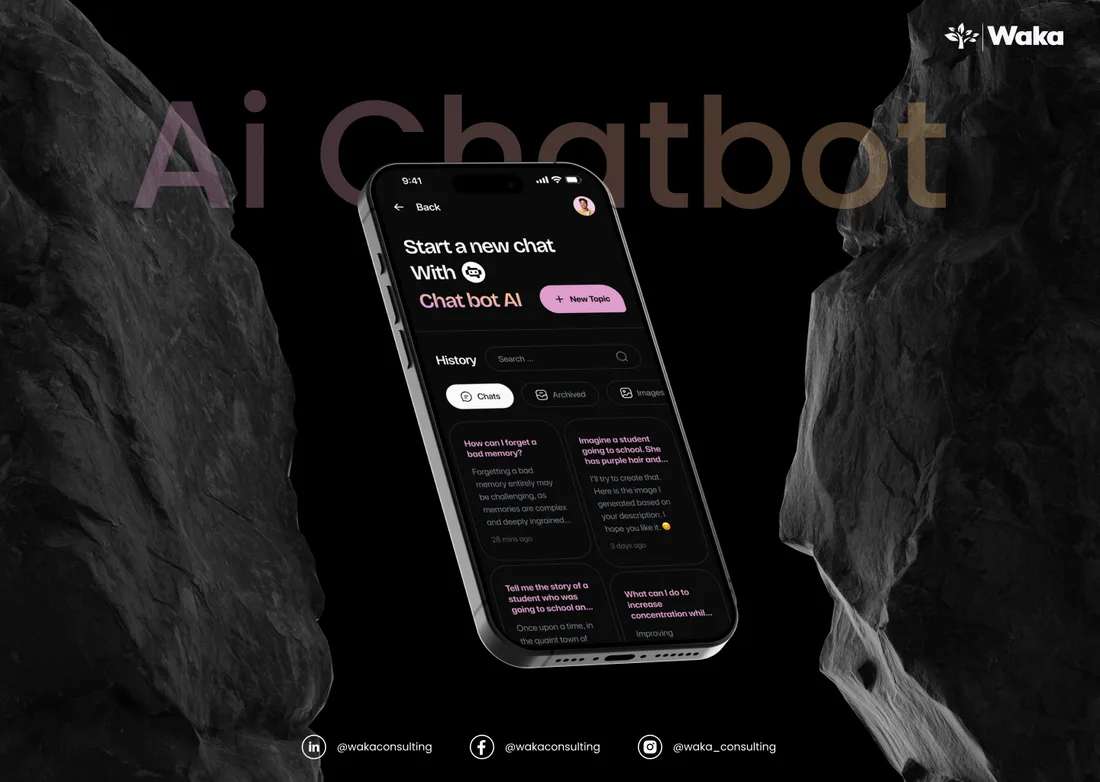
- Project type
- AI interface concept
- Primary audience
- Everyday AI users
- Waka's role
- Product UX and UI
- Outcome
- Conversation model
Helping users begin with intent instead of an empty prompt
An open prompt field looks simple, but it transfers the entire burden of understanding the product to the user. People must know what the assistant can do, how to ask, and how to recover useful work later.
The concept adds lightweight orientation around the conversation: topic creation, visible examples, searchable history, and organization patterns. The aim is to help users begin and return without turning the interface into a complicated command center.
Adding guidance without making an AI conversation feel constrained
The product needs to reduce uncertainty for new users while preserving open-ended interaction for experienced users. It must also communicate model limits, privacy expectations, and the difference between generated output and verified information.
Give users a clear way to start a purposeful conversation.
Make prior work searchable and recognizable.
Keep advanced organization available without cluttering the main action.
Create room for honest AI limitations and privacy guidance.
The choices that shaped the product direction
The concept was developed as a connected system. Each decision supports the same outcome: helping a learner understand what to do without unnecessary explanation.
Give topic creation a clear entry point
A visible new-topic action turns starting into a product decision rather than leaving the user alone with an unexplained field.
Guide the first useful actionMake history meaningful
Conversation cards, time context, filters, and search help users recognize prior work instead of treating every chat as disposable.
Past work should be reusableUse examples as orientation
Examples can demonstrate task types and good input structure without pretending that every output is equally reliable.
Examples teach product scopeReserve space for trust information
Privacy, data handling, verification, and model limitations should be designed into the journey rather than buried after launch.
Trust is a product featureA conversation lifecycle beyond the prompt box
The interface supports the work before, during, and after a generated response.
Orient
Understand useful task types, examples, and important limits.
Prompt
Start a focused topic and provide the context the task requires.
Review
Evaluate, refine, and verify the generated response.
Reuse
Search, organize, and return to useful conversation history.
A mobile direction for useful, recoverable AI conversations
- AI task framing
- New-topic flow
- Conversation history model
- Search and filtering direction
- Mobile visual system
- Trust-content requirements
A concept that makes AI interaction easier to start and revisit
The direction expands the AI experience beyond an empty prompt by connecting orientation, conversation, review, and reusable history.
A clearer entry point for starting purposeful work
Searchable and recognizable conversation history
A product structure that can accommodate trust and limitation guidance
What product teams can reuse from this work
- A blank prompt is minimal UI but often poor onboarding.
- Conversation history becomes more valuable when users can recognize and organize it.
- AI output needs review and verification pathways, not just generation.
- Privacy and model limits should be designed into the product from the start.
About the project and its evidence
Is this the NeuroPulse project?
The local artwork shows an AI chatbot, while older site copy used the name NeuroPulse for a decision-intelligence dashboard. This page follows the visible evidence and does not claim they are the same product.
Does the concept include a production AI model?
No production model, accuracy result, or live deployment is claimed.
What would production require?
A production build would require model selection, safety evaluation, data controls, retention rules, prompt and response logging policy, abuse prevention, accessibility, monitoring, and clear user guidance.
Design AI around useful work, not novelty alone.
Waka connects product thinking, interface design, development, and launch support in one delivery flow.